A few years ago, Matagot contacted me directly for work on the English translation of an upcoming game. It was the first time they'd done so (but not the last). I did my usual - I read the rules, I suggested changes, and I sent it back. I thought it looked like fun, but I wasn't sure.
Time passed, and I received my contributor copy - but I managed to get one of those flukes that I often get - my copy was missing a part. I have terrible luck, which has led to my having first-hand knowledge of how dozens of companies handle customer service for defective things.
But when I received my replacement, I was in the middle of a project. So I set it aside and vowed to get to it later. When it finally hit the table, we played the fully-cooperative game and it was ... okay. I guess.
But the rules have multiple modes of play, one of which was a semi-cooperative game. It looks like it had potential, so I eventually talked the group into giving it another shot - and man I am glad I did.
Room 25 has rapidly become one of my favorite games for up to eight players. Now, before you get too excited, note that you need the Season Two expansion to hit eight players. And the photos below show the figures and some rooms from the expansion.
In Room 25, players each control a character who is participating in a game or reality show. This show, however, has more in common with The Running Man than with Jeopardy! Throw in a healthy dose of Cube, and you've got the game. The goal is to escape the maze with the rest of the party.
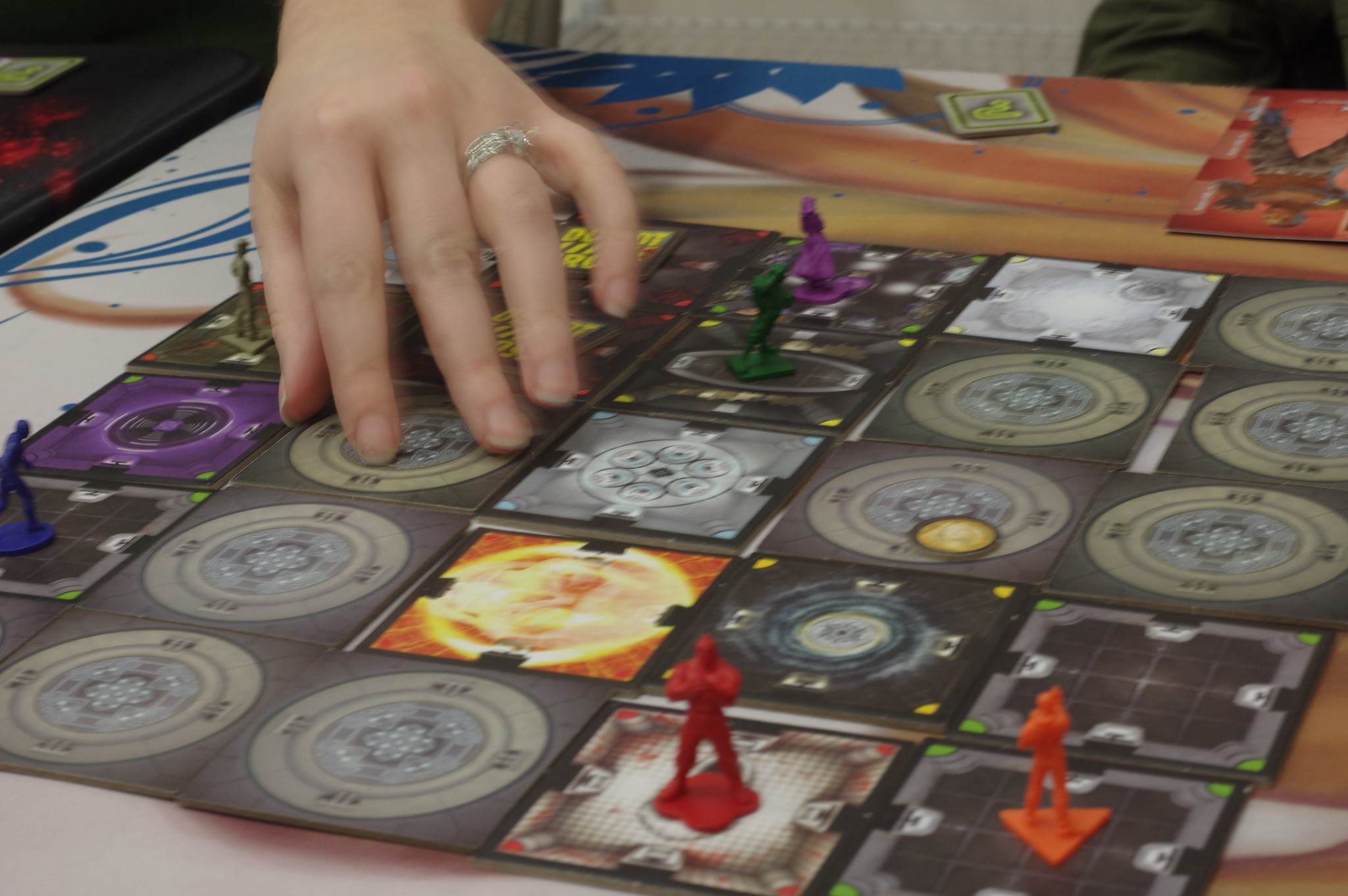
Even in the cooperative mode of play, it's not easy. Each turn, you have to pre-program one or two actions, which will be resolved in order. Those actions are Move, Peek, Shove, and Slide. Move allows your character to move into an adjacent room. Peek lets you look into an adjacent room. Shove lets you push a character into an adjacent room. Finally, Slide lets you move the rooms around.
You want to move and reveal rooms - but you don't want to charge into just any adjacent room, because some rooms will kill you. And if too many players die, the other players can't win. Other rooms will slow you down, disorient you, or prevent table-talk. Rooms can move you around, or make passage impossible without help.
Speaking of table-talk - when you peek, you can't tell others what the room is. All you can do is share the color of the room. Rooms are Red (deadly), Yellow (inconvenient), Green (beneficial), or Blue (Room 25 and the start room).
The reason you want to reveal rooms is because the only way to escape is to get everyone into Room 25 and then slide the room off of the board.
And - again - you have a limited amount of time in which to do so.
And - I'm going to say this again - the cooperative mode is so-so, but it's worth playing to figure out how this game works. Because if you just dump everyone into the semi-cooperative mode, you're not going to do very well.
This game also allows for team play, and, best of all, semi-cooperative play.
But the semi-cooperative mode is absolutely worth the time spent learning the basics.
It adds a few details - there is a player who is a traitor (called a "Guard"). The goal of the traitor is to keep the other players from winning. In an eight-player game, there might be two Guards.
It means that players suddenly can't trust one another completely. If I say a room is Green, is it Green or am I trying to lure you into it?
The pre-programmed nature of the game can work against players, too, because you must take a programmed action, if possible. So if you program a Peek and then a Move, but the board shifts before you Move, you might not have any good choices for that movement. But the Guards can choose to reveal that they are Guards, which means they no longer need to pre-program their actions.
It's powerful, but other players who know you're the Guard will try to shove you into deadly rooms or shift the board to move you away from the rest of them. Of course, you're trying to do the same, but while trying to make it look like an accident or a mistake. Which is tricky.
The game hit the table occasionally for a while, and then the expansion hit.
So I love this game. A lot. It's easily one of my Top Ten of the last few years. But the expansion takes everything I love and turns it up even higher.
It increases player count, adds some new rooms, and gives each character a special ability. Each player also gains an "Adrenaline" token that you can program to take a third action at some point during the game. It also has a chart with some suggestions for building the complex in certain ways.
This game now hits the table almost every week. It rewards smart play and cooperation, and players who can think, plan, and communicate well will find it both challenging and fun.
Wednesday, February 24, 2016
Wednesday, February 17, 2016
That Hugo Thing
Posted by
Eric Franklin
I'm eligible this year to nominate for the Hugo awards. And, as I'm a WorldCon member for this year, I'll be eligible to vote in the awards, as well. And nominate next year.
But that Puppy Thing has reared its ugly head again, so I have little or no hope that my nominees will be on the final ballot, which in several cases is a crying shame.
I'm still reading books published last year and consuming as much media as I can to prepare for the nomination process - I have until the end of March, according to the nominations page. And I'm following a ton of blogs that have posted lists of eligible works. One of the best sources I've found is this blog post, which links to a bunch of sites and lists that are open to all (not just Puppy nominees and not just anti-Puppy nominees).
As I said last year, if your argument is "We didn't break any rules," then you're being an asshole and you know it. But I also understand the Puppy perspective. The Hugo Awards have not (for a very long time) reflected sales. So why aren't the popular books winning awards?
And, to me, it reminds me of gaming. Because "fun" and "good" are (all too often) two separate and distinct things. I love Tigris & Euphrates, but it is not a fun game. It's very good, but something is missing in that "fun" equation.
But why aren't the "fun" books winning? Prior to last year, I suspect that they didn't win because the "fun" books are more the territory of the casual reader, and the casual reader is less-likely to spend money to nominate and/or vote on an award.
It's like the Oscars. For years. I would clear my schedule for Oscar Sunday, and I'd sit and I'd watch the awards. They recognized the best of the best! And then in 2000, Gladiator won Best Picture. I was aghast. Yes, I enjoyed the film, but at least three of the other four nominees that year were (in my opinion) better films.
Somewhere along the way, I had become a film snob. Because I had really enjoyed Gladiator when I saw it in the theater, even though it was cliche-ridden and very thin story-wise with characters that were actually fully developed. I still think Chocolat and Crouching Tiger, Hidden Dragon were both better films.
That's not to say "Good" and "Fun" are mutually exclusive. There are a number of books that are both good and fun. But all too often, the books I read for pleasure are not good books. And I freely admit this. I tend to call them "popcorn" books, because that's how quickly I get through them.
Last year, at Hugo nominating time, the Puppies mobilized their forces, and there were record numbers of nominators. They managed to completely shut out five categories - it would have been more, but a number of authors withdrew rather than be on the list due to the actions of the Puppies.
... and yet in nearly a third of the categories, "No Award" was given, as anti-Puppy voters protested categories which were 100% filled with Puppy nominees. Categories with four Puppy nominees and one non-Puppy nominee all went to the non-Puppy, too. In fact, the only Puppy winner was Guardians of the Galaxy - and it would almost certainly have won even without Puppy intervention.
It's worth noting at this point that there are two Puppy factions. There are the "Sad Puppies" and there are the "Rabid Puppies." When No Award was given in so many categories, the Sad Puppies were sad and the Rabid Puppies rejoiced. Because the Rabid Puppies were going to declare a win regardless of what happned, and "No Award" represented the community turning on itself.
It was a mess. It was ugly and it split the SF/F fandom community.
Now I'm not saying that the Puppy nominees didn't deserve to be there. I'm not saying that at all. I read a ton of bad SF/F. And I really enjoy it. But I've always been able to distinguish Good from Fun, at least in my own mind. And many of the Puppy nominees weren't good. They featured unchanging cardboard characters in cliche-riddled plots and situations, and - all too often - guns were the answer.
The Puppy situation, by the way, is a large part of why I'm going to WorldCon again this year. Because the Hugo process requires two successful votes to change.
Someone introduced at Sasquan/WorldCon last year an amendment to the process called "E Pluribus Hugo" (EPH) (PDF link). It'll decrease the impact of slates and slate voting. And the proposal passed last year. To become the new rules, it'll need to pass again this year.
So how does EPH work?
The current system has everyone nominating up to five eligible works. Those are then accumulated, and the top five vote-getters become the final nominees.
Assume there are two slots on the final ballot for this example:
If I only nominate City of Stairs (which was eligible last year), my wife nominates City of Stairs and The Three-Body Problem, and you nominate The Three-Body Problem and The Goblin Emperor, then The Three-Body Problem has three votes, City of Stairs has two votes, and The Goblin Emperor has one vote. It's clear what the top two nominees will be.
Under EPH, each nominator has one vote. Nominating multiple works splits that vote. So in the example above, my nomination for City of Stairs gives it one vote. My wife's nomination gives half a vote to City of Stairs and The Three-Body Problem, and your nomination gives half a vote each to The Three-Body Problem and The Goblin Emperor. This means that City of Stairs would have 1.5 votes, The Three-Body Problem would have 1 vote, and The Goblin Emperor would have .5 votes.
Then EPH goes a step further. Assume that The Goblin Emperor was then knocked out of contention. At this point, rather than your having wasted part of your vote, your vote is re-distributed among your "surviving" nominees. So your .5 vote for The Three-Body Problem now becomes a full vote for that work. This means that City of Stairs now has 1.5, and The Three-Body Problem now has 1.5.
If there's a tie for points, the tied entrant that appears on the fewest ballots disappears, so voting for more things is still useful and a good idea.
With small numbers (three books, three voters, two slots on the final ballot), we're going to see very similar final outcomes. But when dealing with larger numbers of potential nominees and voters, it makes slates less effective. It means that slates like the Puppies are still pretty much guaranteed one slot per category on the final ballot, but it's nearly impossible to completely flood the ballot box with only your candidates.
It levels the playing field in a not-unfair manner. Because some people do conflate "good" with "fun" - and that's not a bad thing. There is no reason for the Hugos to shut out people with different perspectives, either via the nominations process or via the voting process.
Last year, we all lost. Except the hatemongers in the Rabid Puppy camp. The non-Puppies lost because the Puppies silenced them during the nomination process, and then the Puppies lost when the anti-Puppies voted a strict non-Puppy slate.
By the way: I read most of the nominees and voted my conscience. In the Best Novel category, for example, I voted for Ancillary Sword followed by "No Award" in the Best Novel category, because I found The Three-Body Problem to be dull and the other nominees were split between "poorly written" and "too cliched." And Dresden. I'd stopped reading the series long before Skin Game because I grow tired of the invulnerable protagonist. When the series is "The Dresden Files," it's a pretty good guess that Harry Dresden is going to be around for most (if not all) of them. And I usually just can't read single-protagonist series after about five or six books. The Wheel of Time was an exception - it's one book that's about six million pages long. And - by the way - I still haven't finished it.
But voting on EPH is the only reason I'm going to WorldCon this year. Yes, I'm going to some panels. Yes, I'm going to have a good time. But I'm going to the business meeting so I can vote like I did last year.
The meeting was a crazy zoo last year, too, by the way. Filled with tons of procedural questions as everyone used every trick they had in the book to do ... something. There were some jaw-dropping moments for me, too. Like the gentleman who claimed that one year of Puppy-dominated slates was a statistical anomaly that was unlikely to happen again.
The video of the meeting is well-worth watching, even though there are some long slow dull parts.
I ... I kinda can't wait.
But that Puppy Thing has reared its ugly head again, so I have little or no hope that my nominees will be on the final ballot, which in several cases is a crying shame.
I'm still reading books published last year and consuming as much media as I can to prepare for the nomination process - I have until the end of March, according to the nominations page. And I'm following a ton of blogs that have posted lists of eligible works. One of the best sources I've found is this blog post, which links to a bunch of sites and lists that are open to all (not just Puppy nominees and not just anti-Puppy nominees).
As I said last year, if your argument is "We didn't break any rules," then you're being an asshole and you know it. But I also understand the Puppy perspective. The Hugo Awards have not (for a very long time) reflected sales. So why aren't the popular books winning awards?
And, to me, it reminds me of gaming. Because "fun" and "good" are (all too often) two separate and distinct things. I love Tigris & Euphrates, but it is not a fun game. It's very good, but something is missing in that "fun" equation.
But why aren't the "fun" books winning? Prior to last year, I suspect that they didn't win because the "fun" books are more the territory of the casual reader, and the casual reader is less-likely to spend money to nominate and/or vote on an award.
It's like the Oscars. For years. I would clear my schedule for Oscar Sunday, and I'd sit and I'd watch the awards. They recognized the best of the best! And then in 2000, Gladiator won Best Picture. I was aghast. Yes, I enjoyed the film, but at least three of the other four nominees that year were (in my opinion) better films.
Somewhere along the way, I had become a film snob. Because I had really enjoyed Gladiator when I saw it in the theater, even though it was cliche-ridden and very thin story-wise with characters that were actually fully developed. I still think Chocolat and Crouching Tiger, Hidden Dragon were both better films.
That's not to say "Good" and "Fun" are mutually exclusive. There are a number of books that are both good and fun. But all too often, the books I read for pleasure are not good books. And I freely admit this. I tend to call them "popcorn" books, because that's how quickly I get through them.
Last year, at Hugo nominating time, the Puppies mobilized their forces, and there were record numbers of nominators. They managed to completely shut out five categories - it would have been more, but a number of authors withdrew rather than be on the list due to the actions of the Puppies.
... and yet in nearly a third of the categories, "No Award" was given, as anti-Puppy voters protested categories which were 100% filled with Puppy nominees. Categories with four Puppy nominees and one non-Puppy nominee all went to the non-Puppy, too. In fact, the only Puppy winner was Guardians of the Galaxy - and it would almost certainly have won even without Puppy intervention.
It's worth noting at this point that there are two Puppy factions. There are the "Sad Puppies" and there are the "Rabid Puppies." When No Award was given in so many categories, the Sad Puppies were sad and the Rabid Puppies rejoiced. Because the Rabid Puppies were going to declare a win regardless of what happned, and "No Award" represented the community turning on itself.
It was a mess. It was ugly and it split the SF/F fandom community.
Now I'm not saying that the Puppy nominees didn't deserve to be there. I'm not saying that at all. I read a ton of bad SF/F. And I really enjoy it. But I've always been able to distinguish Good from Fun, at least in my own mind. And many of the Puppy nominees weren't good. They featured unchanging cardboard characters in cliche-riddled plots and situations, and - all too often - guns were the answer.
The Puppy situation, by the way, is a large part of why I'm going to WorldCon again this year. Because the Hugo process requires two successful votes to change.
Someone introduced at Sasquan/WorldCon last year an amendment to the process called "E Pluribus Hugo" (EPH) (PDF link). It'll decrease the impact of slates and slate voting. And the proposal passed last year. To become the new rules, it'll need to pass again this year.
So how does EPH work?
The current system has everyone nominating up to five eligible works. Those are then accumulated, and the top five vote-getters become the final nominees.
Assume there are two slots on the final ballot for this example:
If I only nominate City of Stairs (which was eligible last year), my wife nominates City of Stairs and The Three-Body Problem, and you nominate The Three-Body Problem and The Goblin Emperor, then The Three-Body Problem has three votes, City of Stairs has two votes, and The Goblin Emperor has one vote. It's clear what the top two nominees will be.
Under EPH, each nominator has one vote. Nominating multiple works splits that vote. So in the example above, my nomination for City of Stairs gives it one vote. My wife's nomination gives half a vote to City of Stairs and The Three-Body Problem, and your nomination gives half a vote each to The Three-Body Problem and The Goblin Emperor. This means that City of Stairs would have 1.5 votes, The Three-Body Problem would have 1 vote, and The Goblin Emperor would have .5 votes.
Then EPH goes a step further. Assume that The Goblin Emperor was then knocked out of contention. At this point, rather than your having wasted part of your vote, your vote is re-distributed among your "surviving" nominees. So your .5 vote for The Three-Body Problem now becomes a full vote for that work. This means that City of Stairs now has 1.5, and The Three-Body Problem now has 1.5.
If there's a tie for points, the tied entrant that appears on the fewest ballots disappears, so voting for more things is still useful and a good idea.
With small numbers (three books, three voters, two slots on the final ballot), we're going to see very similar final outcomes. But when dealing with larger numbers of potential nominees and voters, it makes slates less effective. It means that slates like the Puppies are still pretty much guaranteed one slot per category on the final ballot, but it's nearly impossible to completely flood the ballot box with only your candidates.
It levels the playing field in a not-unfair manner. Because some people do conflate "good" with "fun" - and that's not a bad thing. There is no reason for the Hugos to shut out people with different perspectives, either via the nominations process or via the voting process.
Last year, we all lost. Except the hatemongers in the Rabid Puppy camp. The non-Puppies lost because the Puppies silenced them during the nomination process, and then the Puppies lost when the anti-Puppies voted a strict non-Puppy slate.
By the way: I read most of the nominees and voted my conscience. In the Best Novel category, for example, I voted for Ancillary Sword followed by "No Award" in the Best Novel category, because I found The Three-Body Problem to be dull and the other nominees were split between "poorly written" and "too cliched." And Dresden. I'd stopped reading the series long before Skin Game because I grow tired of the invulnerable protagonist. When the series is "The Dresden Files," it's a pretty good guess that Harry Dresden is going to be around for most (if not all) of them. And I usually just can't read single-protagonist series after about five or six books. The Wheel of Time was an exception - it's one book that's about six million pages long. And - by the way - I still haven't finished it.
But voting on EPH is the only reason I'm going to WorldCon this year. Yes, I'm going to some panels. Yes, I'm going to have a good time. But I'm going to the business meeting so I can vote like I did last year.
The meeting was a crazy zoo last year, too, by the way. Filled with tons of procedural questions as everyone used every trick they had in the book to do ... something. There were some jaw-dropping moments for me, too. Like the gentleman who claimed that one year of Puppy-dominated slates was a statistical anomaly that was unlikely to happen again.
The video of the meeting is well-worth watching, even though there are some long slow dull parts.
I ... I kinda can't wait.
Wednesday, February 10, 2016
Hitting The Table: Barony
Posted by
Eric Franklin
As I mentioned last week, I've been playing some really good games lately that I want to talk about. Again, as I mentioned last week, these are games I'd worked on so I didn't pay for my copies.
Today, I'm going to talk about Barony.
Barony is another of those games that is surprisingly easy to play rules-wise, but which reveals a surprising amount of depth in play.
People have been comparing this game to a cross between Settlers of Catan and Chess. And I don't think I'd argue too hard with some of those comparisons.
In Barony, you are trying to get yourself promoted to the rank of Baron. You do this by selling resources back to the bank. You don't gather resources from a random roll, however. You gather resources by building.
As soon as someone hits that rank, the game ends at the end of the round.
There are six different actions you can take in your turn:
1) Move Knights
2) Turn Knights into Buildings
3) Turn Settlements into Cities
4) Sell Resources to Promote Yourself
5) Recruit Knights
6) Expand
This isn't the order they're listed in the rulebook, by the way.
There are restrictions on some of these - you can't enter a space that has an opponent's city, for example. You can't build a city in the forest. You don't get change when selling resources to the bank. They're mostly sensible restrictions, but they still exist.
The board is made up of three-hex tiles and it's randomized before every game.
So what makes it so thinky that people are comparing it to Chess or Go?
It's potentially unforgiving. If you make a mistake with your initial placement, your opponents will be able to keep you from growing in a couple of ways.
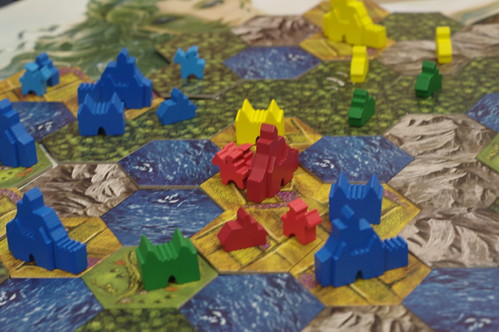
See this picture?

Red is screwed, here. You can't move Knights onto spaces with opposing cities (the blue on i nthe foreground) or strongholds (the yellow and green and blue structures that are also right there). You can't move Knights into the water. And you can't unrecruit knights. Since each player only has seven knights available to them, the Red player, here, has three knights who aren't going anywhere.
Since knights are the only moving unit in the game, that's huge. Building cities requires settlements. Building settlements requires knights. So this Red player (me, by the way), has half of his ability to expand tied up in a way that will never expand. In theory, their pieces can be killed off by Green and or Blue, to return them to supply, but in practice, Yellow, Green, and Blue are going to laugh at Red for having put themselves in a completely untenable situation.
It's a bit slow-moving at first. Players are trying to expand, but they're also trying not to leave their settlements undefended. When a settlement is destroyed, the attacking player gets to take resources from their victim. Eventually, however, the game speeds up.
The "build" action, wherein knights turn into settlements and strongholds is unlimited - you can turn all seven knights into settlements or strongholds if they're all in play. When you build, you also take a resource that matches the hex you're building in. Fields are the most valuable; Mountains are the least. And, if you build seven settlements in a turn, it'll be hard for your opponents to take enough of them from you to keep you from promoting yourself the next turn.
When someone hits the end of the rank track, as I mentioned, the game ends at the end of the round. Players take their current score and add to it a value that's printed on the resource tiles. Again, this value is non-random.
Most points wins. Most of the time, the winner will be the player who triggered the final round, but if someone has been hoarding resources (and the other players haven't noticed or done anything about it), it's possible that they will grab a win.
It's a solid game. The components are really nice, and are distinctively shaped by type.
I only got to demo this a few times at GenCon, but it hits the table most Wednesdays these days.
Today, I'm going to talk about Barony.
Barony is another of those games that is surprisingly easy to play rules-wise, but which reveals a surprising amount of depth in play.
People have been comparing this game to a cross between Settlers of Catan and Chess. And I don't think I'd argue too hard with some of those comparisons.
In Barony, you are trying to get yourself promoted to the rank of Baron. You do this by selling resources back to the bank. You don't gather resources from a random roll, however. You gather resources by building.
As soon as someone hits that rank, the game ends at the end of the round.
There are six different actions you can take in your turn:
1) Move Knights
2) Turn Knights into Buildings
3) Turn Settlements into Cities
4) Sell Resources to Promote Yourself
5) Recruit Knights
6) Expand
This isn't the order they're listed in the rulebook, by the way.
There are restrictions on some of these - you can't enter a space that has an opponent's city, for example. You can't build a city in the forest. You don't get change when selling resources to the bank. They're mostly sensible restrictions, but they still exist.
The board is made up of three-hex tiles and it's randomized before every game.
So what makes it so thinky that people are comparing it to Chess or Go?
It's potentially unforgiving. If you make a mistake with your initial placement, your opponents will be able to keep you from growing in a couple of ways.
See this picture?

Red is screwed, here. You can't move Knights onto spaces with opposing cities (the blue on i nthe foreground) or strongholds (the yellow and green and blue structures that are also right there). You can't move Knights into the water. And you can't unrecruit knights. Since each player only has seven knights available to them, the Red player, here, has three knights who aren't going anywhere.
Since knights are the only moving unit in the game, that's huge. Building cities requires settlements. Building settlements requires knights. So this Red player (me, by the way), has half of his ability to expand tied up in a way that will never expand. In theory, their pieces can be killed off by Green and or Blue, to return them to supply, but in practice, Yellow, Green, and Blue are going to laugh at Red for having put themselves in a completely untenable situation.
It's a bit slow-moving at first. Players are trying to expand, but they're also trying not to leave their settlements undefended. When a settlement is destroyed, the attacking player gets to take resources from their victim. Eventually, however, the game speeds up.
The "build" action, wherein knights turn into settlements and strongholds is unlimited - you can turn all seven knights into settlements or strongholds if they're all in play. When you build, you also take a resource that matches the hex you're building in. Fields are the most valuable; Mountains are the least. And, if you build seven settlements in a turn, it'll be hard for your opponents to take enough of them from you to keep you from promoting yourself the next turn.
When someone hits the end of the rank track, as I mentioned, the game ends at the end of the round. Players take their current score and add to it a value that's printed on the resource tiles. Again, this value is non-random.
Most points wins. Most of the time, the winner will be the player who triggered the final round, but if someone has been hoarding resources (and the other players haven't noticed or done anything about it), it's possible that they will grab a win.
It's a solid game. The components are really nice, and are distinctively shaped by type.
I only got to demo this a few times at GenCon, but it hits the table most Wednesdays these days.
A Plug For A Friend
Posted by
Eric Franklin
This is going up a few minutes in advance of my usual weekly post's schedule (which may be a bit later today, actually), because I want to encourage you to take a look at a Kickstarter project that a buddy of mine is involved with for which I am a backer, and which ends fairly soon.
The project is Street Kings, and, as I type this, it's about $3k shy of its $18,000 goal, and the 48-hour reminder notices should start going out soon (they'll be out by the time you see this), which will help, but I'd like to invite you to click through and take a look at the game.
Read some reviews. Watch some videos. See if this is a game you're likely to play.
And then, if it looks like it is, throw some money at it.
The project is Street Kings, and, as I type this, it's about $3k shy of its $18,000 goal, and the 48-hour reminder notices should start going out soon (they'll be out by the time you see this), which will help, but I'd like to invite you to click through and take a look at the game.
Read some reviews. Watch some videos. See if this is a game you're likely to play.
And then, if it looks like it is, throw some money at it.
Wednesday, February 03, 2016
Hitting the Table: Shakespeare
Posted by
Eric Franklin
There a couple that have hit the table lately that I have really enjoyed, and that I haven't really talked about much here, so I'm going to start to remedy that right now.
Shortly after GenCon, I received a shipment of games that I'd worked on from Asmodee. That shipment included Shakespeare and Barony, along with several others.
I'd spent most of GenCon demoing Starfighter - and I still think that Starfighter was the best game in the booth - but Barony was another game that my team covered and that I needed to be familiar with.
I only ran a few Barony demos, but I liked the game. It was simple to learn and very playable. So I looked forward to getting it to the table at home.
And ... time passed. Several of the Wednesday game folks are theater geeks, so Shakespeare hit the table long before Barony did. And Shakespeare was a hit. And rightly so. But, because it hit the table first, I'm going to talk about it first.

In Shakespeare, you are trying to produce the best play. You start with four characters available to you, but as the game goes on, you will draft more characters (one per turn, in fact), most of whom will give you additional actions.
But it's all about the play.
On your turn, you need to bid how many actions you're taking that turn. Fewest actions bid gets to go first. Each action will do one of a handful of things - you can assemble costumes for your actors, you can dress your set, you can improve your overall ambiance, you can raise money, or you can advance on one of the three "act" tracks.
Most of these will help you advance your overall score.
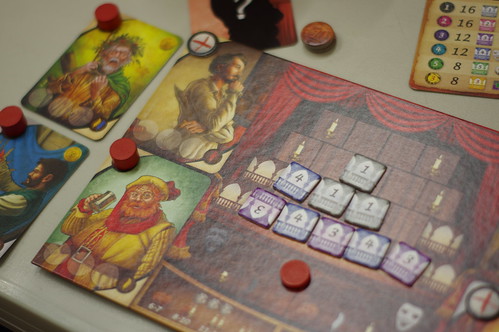
There are two basic character types: Actors and Craftspeople. Craftspeople can dress your set or make costumes for your characters (depending on types). Actors have spaces for costumes on the bottom of their cards (in the image above, the characters pictured are all actors and none of them have costumes underway).
Set pieces have special effects that trigger once played. Especially good costumes can score points and other benefits, as well, and you want your characters in full costume, because only then can you use that actor during Rehearsal.
Twice during the game (near the end), you will hold rehearsals in which actors who have their full costumes (three pieces) also have a special ability that they can trigger. The vast majority of these allow you to advance one of the three "act" tracks that's on the main board. And then you score the three Acts.
If it sounds like there are a lot of moving pieces in this game, it's because there are. Each player has one board (pictured above), and five Action discs (in the corners of three of the characters pictured above), four or five marker tokens (on the Ambiance track in the pic above), and a recruitment marker that shows when they've done their recruiting for the turn.
Then there is a main board which tracks the score, the turn order, and players' progress along the various Acts (which are worth money or victory points when scored). It also provides a pool for the set and costume pieces which are available each turn, and most players set the character cards for recruitment near it, too.
But, despite all of the moving pieces, this game flows really well. New players will struggle for a turn or two (and are definitely at a disadvantage against experienced players), but the flow of the game is pretty logical.
It's a tricky game. Like most games, you want to make sure that you're not wasting actions, but you also don't want to bid too few and be left short. And characters who work one turn need to take the next turn off - so it's possible that you'll have more actions than you can use if you aren't paying enough attention.
I've seen players focus on one scoring area and do well, but I've found that trying to do well in two (or more) areas is more successful.
It's a tight game, too. It only runs for six turns, with rehearsals in turns Four and Six. After turn Six, you need to pay most of your characters. If you can't, each unpaid character costs you victory points.
The winning scores I've seen in this game have been under twenty, and the span from first to fourth has usually been less than five points. It's possible that the winning scores will increase as we get more familiar with the characters and what options exist.
This game is at an intermediate difficulty. Play is a little bit dry, and there very little direct player interaction.
This game is beautifully illustrated, and the component quality is very high.
All in all, this game has earned a spot in the car. It sees regular play, and will likely continue to do so for some time.
Shortly after GenCon, I received a shipment of games that I'd worked on from Asmodee. That shipment included Shakespeare and Barony, along with several others.
I'd spent most of GenCon demoing Starfighter - and I still think that Starfighter was the best game in the booth - but Barony was another game that my team covered and that I needed to be familiar with.
I only ran a few Barony demos, but I liked the game. It was simple to learn and very playable. So I looked forward to getting it to the table at home.
And ... time passed. Several of the Wednesday game folks are theater geeks, so Shakespeare hit the table long before Barony did. And Shakespeare was a hit. And rightly so. But, because it hit the table first, I'm going to talk about it first.

In Shakespeare, you are trying to produce the best play. You start with four characters available to you, but as the game goes on, you will draft more characters (one per turn, in fact), most of whom will give you additional actions.
But it's all about the play.
On your turn, you need to bid how many actions you're taking that turn. Fewest actions bid gets to go first. Each action will do one of a handful of things - you can assemble costumes for your actors, you can dress your set, you can improve your overall ambiance, you can raise money, or you can advance on one of the three "act" tracks.
Most of these will help you advance your overall score.
There are two basic character types: Actors and Craftspeople. Craftspeople can dress your set or make costumes for your characters (depending on types). Actors have spaces for costumes on the bottom of their cards (in the image above, the characters pictured are all actors and none of them have costumes underway).
Set pieces have special effects that trigger once played. Especially good costumes can score points and other benefits, as well, and you want your characters in full costume, because only then can you use that actor during Rehearsal.
Twice during the game (near the end), you will hold rehearsals in which actors who have their full costumes (three pieces) also have a special ability that they can trigger. The vast majority of these allow you to advance one of the three "act" tracks that's on the main board. And then you score the three Acts.
If it sounds like there are a lot of moving pieces in this game, it's because there are. Each player has one board (pictured above), and five Action discs (in the corners of three of the characters pictured above), four or five marker tokens (on the Ambiance track in the pic above), and a recruitment marker that shows when they've done their recruiting for the turn.
Then there is a main board which tracks the score, the turn order, and players' progress along the various Acts (which are worth money or victory points when scored). It also provides a pool for the set and costume pieces which are available each turn, and most players set the character cards for recruitment near it, too.
But, despite all of the moving pieces, this game flows really well. New players will struggle for a turn or two (and are definitely at a disadvantage against experienced players), but the flow of the game is pretty logical.
It's a tricky game. Like most games, you want to make sure that you're not wasting actions, but you also don't want to bid too few and be left short. And characters who work one turn need to take the next turn off - so it's possible that you'll have more actions than you can use if you aren't paying enough attention.
I've seen players focus on one scoring area and do well, but I've found that trying to do well in two (or more) areas is more successful.
It's a tight game, too. It only runs for six turns, with rehearsals in turns Four and Six. After turn Six, you need to pay most of your characters. If you can't, each unpaid character costs you victory points.
The winning scores I've seen in this game have been under twenty, and the span from first to fourth has usually been less than five points. It's possible that the winning scores will increase as we get more familiar with the characters and what options exist.
This game is at an intermediate difficulty. Play is a little bit dry, and there very little direct player interaction.
This game is beautifully illustrated, and the component quality is very high.
All in all, this game has earned a spot in the car. It sees regular play, and will likely continue to do so for some time.
Wednesday, January 27, 2016
BGG's Top Fifty, Staying Power, and Old Games
Posted by
Eric Franklin
Like a lot of people, I spend time watching the top games on Boardgamegeek, because it's always interesting to watch what games people consider to be The Best of All Time, even if I often disagree with the ratings.
In fact, people often speak of the "Cult of the New" to describe games on the list, because new games will often rocket to the top of the list before gradually settling on down the list. It's exacerbated because people don't often go through and review their ratings and adjust them. And then "older" games hit the table less-frequently, and so even people who are fastidious about updating their ratings don't update older games in comparison to newer games.
This last weekend, I discovered that Tigris & Euphrates was available on my Kindle Fire. This game initially hit at about the same time as Settlers of Catan and Carcassonne. It was part of the first wave of Euro-style games to hit with hobbyists here in North America. I remember playing it a few years before I started tracking games on BGG.
And it's a really good game. But it's a fairly dry abstract and it's a real brain-burner. These are both things that tend to hurt a game's numbers in the ratings game.
BUT it was re-released with a new edition in 2015, which makes it visible again and (often) boosts its ratings ... right?
So I did some searching and I found this thread, which (thankfully) includes T&E in its ratings. It doesn't go through 2015, but it does go through September of 2014. So I was shocked to discover that its re-release hadn't improved its ratings. Or, honestly, made much of a difference to them at all.
In September of 2014, it was 31 on the list. As of this writing, it's 38. It's the third-oldest game in the Top 50, in fact. Crokinole and El Grande are the only two Top Fifty games that are older that are in the Top 50.
Only four games from 2015 are in the Top Fifty. Seven games from 2014. The year with the most games? 2012 has eleven games. I wonder - if I went back four years and did a similar analysis, would 2008 have a similar spike? Or was 2012 just an amazing year for games?
There is one (standalone) expansion on the list, Dominion Intrigue. It's rated higher than its base game. War of the Ring is on there twice in two different editions. Two other games have their second editions listed, too. Game of Thrones and Descent: Journeys in the Dark. But the first editions for these games is not on the list.
Keep in mind - according to hobby gamers who visit BoardGameGeek (and rate games), these are the fifty best games of all time. And the average game was released midway through 2007. If you remove Crokinole from the listings, the average game was released in early 2010.
I'm not going to say these aren't good games, because they're not. Many of these are absolutely fantastic games. But where are the classics? I'm not talking "Mass-market hits," here. I'm talking games which have very much stood the test of time. Go is #78 on the list. Chess is #344. Backgammon is #955. That's insane.
Do I think the Cult of the New is a problem? Yes, but not to the same degree as many other folks seem to feel it is. And not for the same reasons.
I think that this list is an excellent guide for good hobby games, but using this as a list of the Best Games of All Time will leave the reader disappointed.
If I were running a game store, I'd keep track of the top ten or twenty or so, because these are the games which have had diverse appeal over the last few years - and their very presence on the list can lead to further sales for new gamers.
Not everyone will agree with all of these ratings. Me, for example. Of the 21 games I've rated that are on the list, my average rating is just over 7.2. At least one game on the list is one I rated a 4.
To find games that you might like, you're better off checking them by category. Pick a category, scroll down to "linked items" and where it says "sort," chose "rank," and it'll re-organize the list of games based on other peoples' ratings. And even that is no guarantee, because you may like a game that most people dislike (and vice versa).
Something to think on, I guess.
In fact, people often speak of the "Cult of the New" to describe games on the list, because new games will often rocket to the top of the list before gradually settling on down the list. It's exacerbated because people don't often go through and review their ratings and adjust them. And then "older" games hit the table less-frequently, and so even people who are fastidious about updating their ratings don't update older games in comparison to newer games.
This last weekend, I discovered that Tigris & Euphrates was available on my Kindle Fire. This game initially hit at about the same time as Settlers of Catan and Carcassonne. It was part of the first wave of Euro-style games to hit with hobbyists here in North America. I remember playing it a few years before I started tracking games on BGG.
And it's a really good game. But it's a fairly dry abstract and it's a real brain-burner. These are both things that tend to hurt a game's numbers in the ratings game.
BUT it was re-released with a new edition in 2015, which makes it visible again and (often) boosts its ratings ... right?
So I did some searching and I found this thread, which (thankfully) includes T&E in its ratings. It doesn't go through 2015, but it does go through September of 2014. So I was shocked to discover that its re-release hadn't improved its ratings. Or, honestly, made much of a difference to them at all.
In September of 2014, it was 31 on the list. As of this writing, it's 38. It's the third-oldest game in the Top 50, in fact. Crokinole and El Grande are the only two Top Fifty games that are older that are in the Top 50.
Only four games from 2015 are in the Top Fifty. Seven games from 2014. The year with the most games? 2012 has eleven games. I wonder - if I went back four years and did a similar analysis, would 2008 have a similar spike? Or was 2012 just an amazing year for games?
There is one (standalone) expansion on the list, Dominion Intrigue. It's rated higher than its base game. War of the Ring is on there twice in two different editions. Two other games have their second editions listed, too. Game of Thrones and Descent: Journeys in the Dark. But the first editions for these games is not on the list.
Keep in mind - according to hobby gamers who visit BoardGameGeek (and rate games), these are the fifty best games of all time. And the average game was released midway through 2007. If you remove Crokinole from the listings, the average game was released in early 2010.
I'm not going to say these aren't good games, because they're not. Many of these are absolutely fantastic games. But where are the classics? I'm not talking "Mass-market hits," here. I'm talking games which have very much stood the test of time. Go is #78 on the list. Chess is #344. Backgammon is #955. That's insane.
Do I think the Cult of the New is a problem? Yes, but not to the same degree as many other folks seem to feel it is. And not for the same reasons.
I think that this list is an excellent guide for good hobby games, but using this as a list of the Best Games of All Time will leave the reader disappointed.
If I were running a game store, I'd keep track of the top ten or twenty or so, because these are the games which have had diverse appeal over the last few years - and their very presence on the list can lead to further sales for new gamers.
Not everyone will agree with all of these ratings. Me, for example. Of the 21 games I've rated that are on the list, my average rating is just over 7.2. At least one game on the list is one I rated a 4.
To find games that you might like, you're better off checking them by category. Pick a category, scroll down to "linked items" and where it says "sort," chose "rank," and it'll re-organize the list of games based on other peoples' ratings. And even that is no guarantee, because you may like a game that most people dislike (and vice versa).
Something to think on, I guess.
Wednesday, January 20, 2016
Late Kickstarter Update
Posted by
Eric Franklin
I think it's about time for my quarterly Kickstarter Update. I'm going to talk more about the later projects than about the ones that are only a little late or are on time.
Here's where I stand in terms of the gaming Kickstarters that I've backed that may or may not be late:
Unfulfilled and Late/Delayed
Powerchords - Still late. This is my longest outstanding project, having funded on October 1, 2010. We had three December updates after two November updates after ... a July update. The author has been giving refunds to backers who asked for them, and he's been a generally pleasant person all around, so I'm willing to wait it out at this point.
Far West - Still late. For many Kickstarter-aware backers, this has become the poster child for late projects. I am the villain who went to his local Attorney General to get his refund. You may have read about me in an update or some comments. I received a partial refund (I'm now a digital-only backer, so I'll eventually get that PDF). We were told to expect Chapter Nine "by Christmas," which hasn't happened. We were told to expect the finished product by the end of January. I'm not holding my breath. The author has continued to be confrontational in tone when dealing with backers, and I don't think we'll ever see this.
The +5 Food of Eating Cookbook - I think I've mentioned this before. I've written it off, really. We have the PDF, but the print version is not coming. The author has dropped off the face of the earth. Which is always sad.
Synnibarr - Raven c.s. McCracken continues his show. I have one PDF. Out of three coming. And three hardcover books which are due. And he doesn't update on Kickstarter. He updates on Facebook. Sometimes in the Synnibarr community and sometimes in his personal FB page. Original due date: December 2013. I think we probably have a longer wait coming for this.
Alas, Vegas - A number of people are angry or upset about this one and its delays. I'm not one of them. James Wallis may release late, but his books are nearly always worth the wait.
Tales From the Floating Vagabond - This was an easy sell for me. TFFV was one of the best comedy games ever released. I'm starting to doubt I'll see a finished print copy, which is a shame. But - again - I'm not angry or upset about this one. It'll arrive when it's done. Or not.
Fae Nightmares - I've had the PDF since September of 2014, but the PDF is not currently available on DTRPG. It's still in my library, but I can't point it out to folks. I know that one of the project creators has had some health problems, and that's probably delaying the release of the print edition.
TimeWatch - Will be here when it gets here. It's a GUMSHOE game, and I do love the system (and I've enjoyed it when I've been able to play), it's not an easy sell for some groups for long-term play. I'll mostly be stealing ideas from it for other things. Because that is what I do with most games these days.
Mobile Frame Zero: Alpha Bandit - I received "final notice" to make sure my shipping address was up-to-date, so this will probably be in my hands soon.
13th Age in Glorantha - They keep giving us playtest PDFs that contain a class or a race or other bits and pieces. No idea when the final finished PDF (or print) will be out, though.
Demon Hunters - I've got my PDF. We had an update the other day. The POD version is going to be available to us soon. I may have my code before this post goes live. Original due date: July 2015.
Esteren - Occultism - They've had to find a new printer, which caused delays. But they're continuing to progress and fight through it.
Grimtooth's Ultimate Traps Collection - I got my PDF in June. We've seen images of the production edition as recently as two weeks ago. I'd say this is on track to be less than a year later than its July 2015 estimated date.
Short Order Heroes: Theme Packs - I still think that Short Order Heroes was one of the best projects I have ever backed. I've gotten a ton of use out of it. This is ... well, it's a matter of waiting for the artist (who is working away). I have no fear that it'll get here, though. And it's only four months late at this point.
Mare Nostrum - Empires - Original estimated date: November 2015. Again: Not concerned. This grew in scope as the project ran, but I have no fear of this failing, either.
Interestingly, there are only three other gaming projects I've backed that aren't late, yet.
Blue Rose, which takes the old d20 setting/supplement and revises to to use Green Ronin's AGE system and which isn't late yet. Mana Surge, which is a game I saw when it was still a prototype and which I'm looking forward to. Shinobigami, which is being done by the same team who did Tenra Bansho Zero and Ryuutama, so I have no fear that it will be equally as amazing.
Received Since Last Update
I'm ... I'm not sure when I last did a Kickstarter update, so here's what I've received since August of last year:
Deluxe Tunnels & Trolls - It was two years late, but it's here. And it's what I'd expected (and what I backed expecting), so I have no complaints on that front.
Two Rooms and a Boom - I don't play many party games, but I'm still glad I backed this one. It's not amazing. It's not groundbreaking or earthshattering or anything, but it's fun. And, with games, that's what matters.
Ryuutama - I haven't read this one thoroughly enough, yet. But I like what I've seen so far. More detail to eventually follow.
Fantaji - I haven't even looked at this, yet. It's ... it's on my "to be read" shelf, and a lot of what I see in it is right in that sweet spot for what I'm looking for in a system, but I'm focused on other things right now.
Feng Shui - This is a time-travel John Woo-style beat 'em up game. It was awesome in its earlier edition, and it's still awesome.\
Riders: A Game About Cheating Doomsday - I really like this one. A lot. It's phenomenal. It's like In Nomine with a ton more flavor. I should spend a weekend and type up my thoughts on this one, because it's that good.
Epic - the latest card game from the Star Realms team. I haven't even looked at the rulebook, yet. Oops.
Subscribe to:
Posts (Atom)